
Most of us don’t realize that the hair we see is just a “dead” string of protein, but the way it’s engineered is wild. That outer layer—the Cuticle—is basically a suit of armor. It’s made of these microscopic shingles that, in a perfect world, stay flat and tight so your hair looks like glass.
But the second you hit it with heavy bleach or a flat iron on max heat, those shingles “flare” up. Once they’re blown open like that, the light doesn’t reflect anymore, and you’re left wondering why your hair feels more like a bale of straw than a head of hair.
Deep inside that “armor” is the Cortex. This is where the real business happens. It’s the engine room that holds your hair’s strength and its color (melanin). This is the part we target at Cult Aesthetics.
The laser ignores the “armor” and hits the pigment inside the cortex to shut things down. Some people have a third, hollow core called the Medulla, but it’s a bit of an evolutionary mystery—finer hairs don’t even have one.
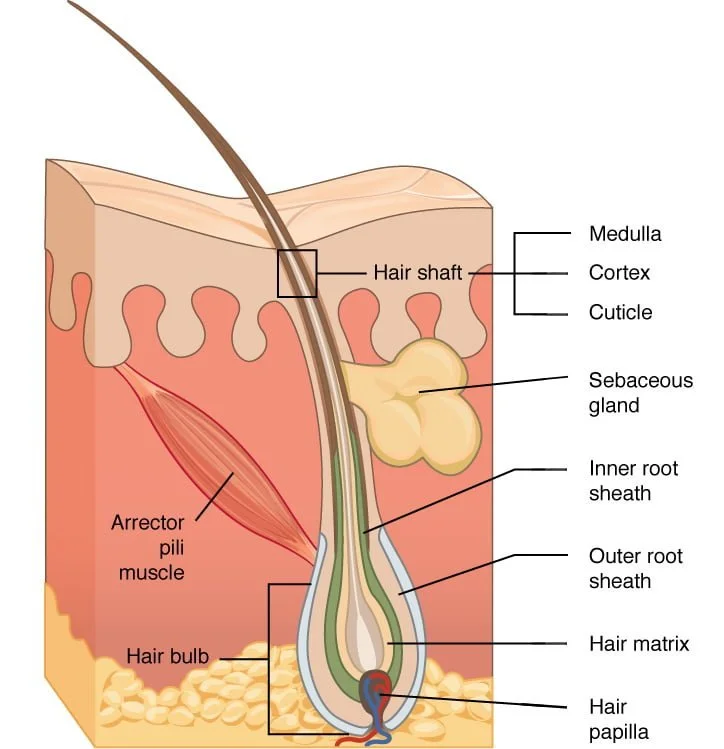
The real life of the hair is hidden in the Follicle. Think of the follicle as a tiny, living pocket in your skin. At the very bottom is the Bulb, and tucked inside that is the Dermal Papilla.
This is the most important part of the anatomy—it’s the “power plug” that connects your hair to your blood supply. As long as that plug is in, the hair grows.
Next to the follicle, you’ve got a Sebaceous Gland (your skin’s natural oil pump) and a tiny muscle called the Arrector Pili.
That muscle is why you get goosebumps; when you’re cold, it pulls the hair upright to try and trap heat. It’s a vestigial leftover from when humans were much hairier!
Hair isn’t a machine that stays “on” all the time. Every follicle on your body is in one of three stages. Most are in Anagen (the growth phase), which is the only time the hair is actually attached to the “power plug.” Eventually, it hits Catagen (the transition), where it lets go of the blood supply, and finally Telogen, where it just rests before falling out.
This cycle is the exact reason we tell our laser patients that one session isn’t enough. We can only destroy the “factory” when the power is plugged in (Anagen). Since your hairs are all on different schedules, we have to wait for the “sleeping” ones to wake up before we can treat them.
The shape of the follicle determines which type of hair you have:
Thickness and texture is also influenced by how much keratin there is, and how closely packed the protein chains are. Asian hair is slightly straight and extremely strong, African hair is coily-kinky with a tendency to be very dry, while Caucasian hair falls in between.
The colour comes from two types of pigment in the cortex:
Gray happens when pigment cells in the bulb slow down or stop working; this mostly happens as you age, but stress can speed the process.
By knowing the anatomy of a hair makes it a lot easier to care for.
Condition, smooth the cuticle and skip heat. Worried about thinning? Take good, tender, loving care of the follicle and dermal papilla & eat nutrition-rich food.
Guarding the cortex from chemicals and abrasive forces.
Hair is stronger than it seems, but it’s also fragile. Take care of it, feed it right, and it can reward you with strength and shine.
And if something feels wrong in any way — like thinning, you’re shedding like crazy or your texture is changed — don’t be afraid to talk to a dermatologist. They’ve got the insides on every strand.
So next time you’re running your fingers through your hair, be a touch more grateful. It’s a tiny miracle of nature, bursting right out of your head every darn day.
We’ve all heard the old wives’ tale: “If you shave your legs, the hair will grow back thicker and darker.” From a biological standpoint, that is impossible. As we discussed in the anatomy section, the hair shaft is dead keratin.
Cutting it at the surface doesn’t send a “memo” back down to the living follicle to produce more hair.
The reason people believe this is because of the geometry of the cut. When hair grows naturally, it has a tapered, soft point. When you shave, you’re cutting the hair at its thickest point—the base.
When that blunt edge starts to peek back through the skin, it feels prickly and looks darker because you’re seeing the full diameter of the shaft all at once. If you’re looking for actual change in hair density, you have to target the “factory” (the follicle) through laser or hormonal treatments; a razor simply isn’t powerful enough to change your DNA.
Ever wonder why your underarms seem to clear up in four sessions, but your upper lip takes ten? It comes down to Follicle Density. Your face has a much higher concentration of hair follicles per square centimeter than your legs do. Additionally, facial hair is often “hormonally driven,” meaning the follicles are more sensitive to the tiny fluctuations in your body’s chemistry.
At Cult Aesthetics, we often see patients who are frustrated that their results aren’t “uniform” across their body. We have to explain the anatomy: your body is a patchwork of different growth cycles.
While your leg hair might be “napping” for long periods, your facial hair is on a fast-track cycle. Understanding this anatomy helps manage expectations—it’s not that the treatment isn’t working; it’s that your facial follicles are just more “ambitious” than the ones on your shins.
We have to be brutally honest about the Cortex and pigment. Since the laser is a heat-seeking missile for melanin, it needs a target. If you have red hair (which contains pheomelanin) or grey/white hair (which has no pigment and a hollow medulla), the laser simply won’t “see” it.
We’ve had people ask if they can dye their hair dark before a session to “trick” the laser. Unfortunately, the anatomy doesn’t work that way. The dye only stains the dead shaft; it doesn’t penetrate the living root where the destruction needs to happen. F
or these hair types, we usually recommend sticking to traditional methods or exploring electrolysis.

Cult Aesthetics is a Cosmetic Surgery chain based in Gurgaon & Delhi. Our journey began in 2019 and under Dr. Gaurav Solanki’s leadership and within a span of 3 years we’ve built a name that many centres seldom make in a decade!
Read more